


Introduction
There are patterns in Scripture not immediately visible to the casual reader—mysteries hidden beneath the surface, waiting to be unveiled by those who seek God not only for knowledge but for His heart. Among these patterns stands the mysterious figure of Melchizedek. He appears abruptly in Genesis, blesses Abraham, receives tithes, and vanishes from the storyline—only to reappear in Psalms and dominate the theology of Hebrews. But Melchizedek is not a random anomaly. He is a prophetic blueprint—an echo of the eternal priesthood and a pattern of throne-based authority concealed from the foundation of the world.
To understand Melchizedek is to understand Christ’s eternal government, the restoration of priesthood and kingship in the Body, and the path by which the saints are invited to rule from union, not ambition. This is not theory—it is invitation. For those with eyes to see, Melchizedek reveals a governmental mantle forged not in religious systems but in divine presence.
What Was Hidden Before Time Began
Christ Slain Before the Foundation
Revelation 13:8 declares Christ as “the Lamb slain from the foundation of the world.” This radical truth confronts every assumption that Calvary was a reaction. The cross was not plan B—it was written into the architecture of eternity. Before Eden’s garden, before Adam’s breath, before Lucifer’s fall, the slain Lamb stood at the center of heaven’s government.
The Greek word used here, katabolēs kosmou (καταβολῆς κόσμου), literally means “the throwing down” or “casting down” of the world. In other words, Christ’s sacrifice wasn’t just foreseen—it was foundational. Before time ticked or matter moved, God’s throne was established on blood. Redemption, intercession, and glory were not inventions of crisis; they were the eternal plan.
The Eternal Throne Preceded the Earth
Psalm 89:14 reveals, “Righteousness and justice are the foundation of Your throne; Mercy and truth go before Your face.” The throne of God is not just a seat of rulership; it is the center of reality, the axis upon which everything visible and invisible turns. Before mountains formed or angels were named, the throne existed—immovable, unshaken, sovereign.
This throne was not earned by Christ; it was eternally His. Hebrews 1:8 says, “Your throne, O God, is forever and ever.” This throne is not figurative—it is literal, spiritual, eternal, and ever-present. And Melchizedek, when he appears, comes not as an invention of Israel’s history but as a shadow of that throne already burning with eternal flame.
Who Is Melchizedek?
A Priest Without Lineage
Hebrews 7:3 describes Melchizedek as “without father, without mother, without genealogy, having neither beginning of days nor end of life, but made like the Son of God.” This passage, rich in mystery, is not saying Melchizedek was divine—but that he was shaped prophetically to reflect something that transcended time. His lack of recorded genealogy is not a biographical gap; it is a theological statement.
In the ancient world, priesthoods were dependent on lineage. You had to be born into the right tribe—Levi—to minister before God. But Melchizedek steps outside this paradigm. His priesthood is not based on bloodline, but on divine ordination. This anticipates Christ, who was born from Judah (not Levi), yet was installed as High Priest forever by the oath of God.
King of Righteousness and Peace
The very name Melchizedek (מַלְכִּי־צֶדֶק) means “King of Righteousness,” and he ruled in Salem (שָׁלֵם), which means “Peace.” These are not throwaway descriptions; they are divine codes. Righteousness and peace are always the byproducts of true authority. Psalm 85:10 says, “Mercy and truth have met together; righteousness and peace have kissed.”
In other words, Melchizedek didn’t merely hold a title—he embodied a heavenly alignment. When righteousness and peace come together, a throne is established. Isaiah 32:17 echoes this: “The work of righteousness will be peace, and the effect of righteousness, quietness and assurance forever.”
Encounter with Abraham
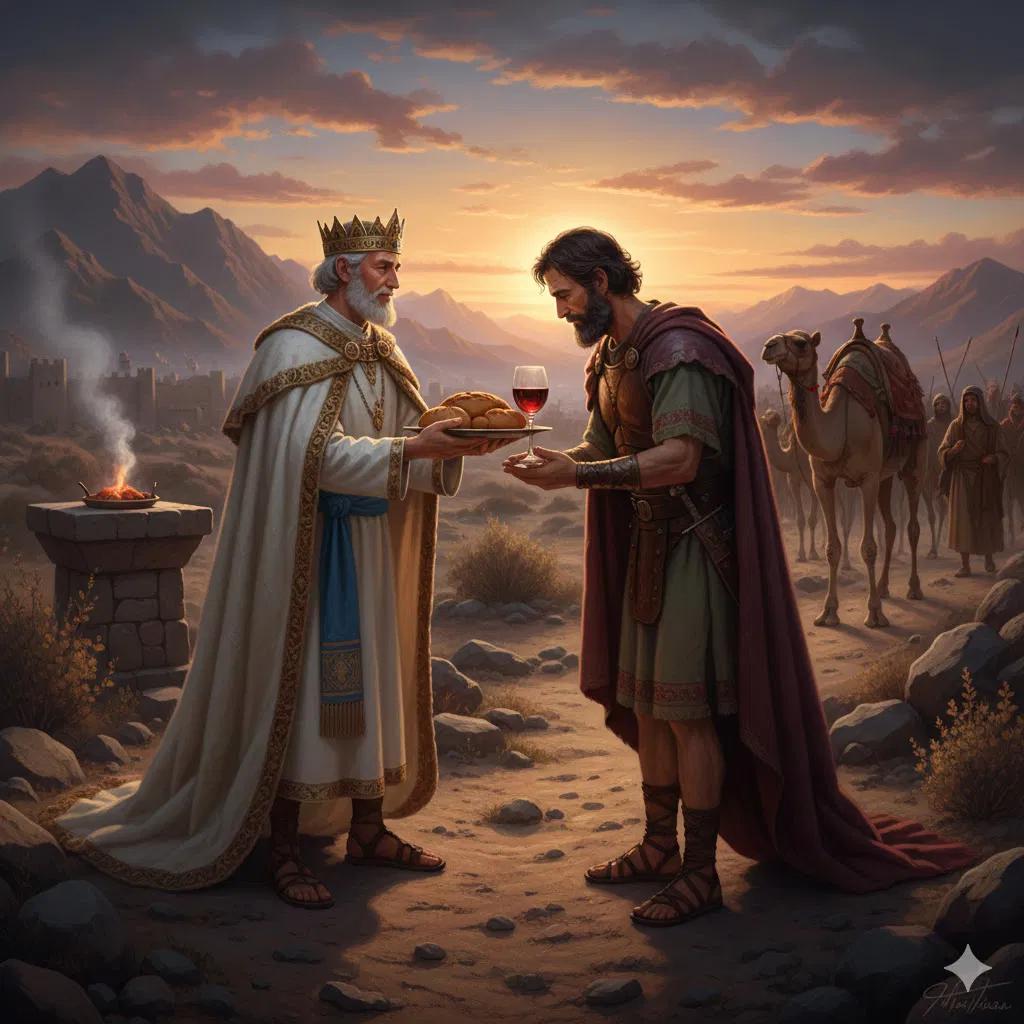
Genesis 14 describes Abraham’s return from war and sudden encounter with this King-Priest. Melchizedek brings out bread and wine (a clear prophetic gesture), blesses Abraham, and receives a tenth of the spoils. This tithe was not law—it was revelation. Abraham, the father of nations, recognized a higher priesthood.
This act sets a precedent: the lesser honors the greater (Hebrews 7:7). Abraham’s tithe was not obligation—it was alignment. He saw throne-based authority and responded. Even Levi, still in Abraham’s loins, tithed that day. This speaks to us: spiritual authority recognizes spiritual order, even before it is fully revealed.
Thrones and Priests: The Divine Design
The First Mention of Thrones
Daniel 7:9 says, “I watched till thrones were put in place, and the Ancient of Days was seated.” Notice: thrones—plural—are prepared before God takes His seat. This hints that the heavenly realm is not a monarchy of isolation, but a kingdom with distributed authority.
Thrones are not symbolic of power; they are seats of responsibility. In the heavenly courtroom, thrones surround the Ancient of Days. These are not earthly governments; they are spiritual spheres, seats of judgment and agreement. Melchizedek was a throne-bearer before Israel had a priest or a king.
Why Thrones Are Linked to Priesthood
Priests minister to God. Kings rule for Him. But Melchizedek embodies both in one figure. Why? Because the highest authority flows from intimacy. Intercession precedes dominion. That’s why Zechariah prophesied of Christ: “He shall be a priest on His throne” (Zechariah 6:13). Not beside the throne—on it.
When priesthood and kingship are divided, the Church either becomes all prayer and no power—or all governance and no glory. But the Melchizedek order unites the two. It is governmental intercession. Thrones are reserved for those who know how to weep between porch and altar.
Thrones in Heaven Versus Thrones on Earth
Earthly thrones are built on conquest. Heavenly thrones are built on covenant. You can seize an earthly crown—but you must be summoned to a heavenly throne. Melchizedek never campaigned, never crowned himself. His authority was recognized by heaven and discerned by Abraham.
This is the divine tension: authority that is hidden, yet acknowledged. That is the model for end-time priesthood—a generation not seeking platforms, but presence. Not obsessed with titles, but faithful in the temple.
Melchizedek and the Royal Priesthood
A King-Priest, Not a Levitical Model
The Levitical priesthood was designed for shadows—rituals, cycles, and external laws. It was temporary and limited. But Melchizedek was not under the law. He carried a priesthood that could never be broken, because it was rooted in heaven, not on Sinai.
This is why 1 Peter 2:9 calls us “a royal priesthood.” The word royal (Greek: basileios) denotes kingship. We are not just intercessors—we are throne-bearers. Christ has made us “kings and priests to our God, and we shall reign on the earth” (Revelation 5:10).
Psalm 110 and the Eternal Oath
Psalm 110 is the most quoted Psalm in the New Testament. Verse 4 says: “The LORD has sworn and will not relent, ‘You are a priest forever according to the order of Melchizedek.’” This priesthood is not inherited—it is sworn by divine oath.
Hebrews 7:21 confirms this: “The Lord has sworn and will not relent…” God binds Himself to this priesthood. That means no man, demon, system, or failure can disqualify what God has sworn. Christ is High Priest forever—and we are joined to His priesthood by covenant.
An Order That Cannot Be Broken
Unlike the Levitical priesthood, which changed hands through death, this order is eternal. “He continues forever and has an unchangeable priesthood” (Hebrews 7:24). The word unchangeable (Greek: aparabatos) means “non-transferable.” This priesthood cannot be passed, sold, corrupted, or manipulated.
And here’s the mystery: you are included. Through Christ, you are invited into the very priesthood that governs the heavens.
The Throne in Hebrews
Jesus as the Seated High Priest
Hebrews 10:12 reveals a staggering reality: “But this Man, after He had offered one sacrifice for sins forever, sat down at the right hand of God.” Unlike Levitical priests who stood daily—offering sacrifices that could never remove sin—Jesus sat down. That means His work is finished, His offering accepted, and His place secured. He did not sit on an earthly throne—He sat at the right hand of majesty in the heavens (Hebrews 8:1).
This throne is not merely an honorific position. It is a place of governance. Christ rules as High Priest, administering redemption, interceding for saints, and preparing a royal priesthood who will sit with Him. The seated posture of Christ is proof that the veil has been torn, the blood has been accepted, and the priesthood is forever.
The Veil, the Blood, and the Mercy Seat
Hebrews 9:12 declares: “Not with the blood of goats and calves, but with His own blood He entered the Most Holy Place once for all, having obtained eternal redemption.” The veil that once separated man from God was torn—not by force, but by flesh. Hebrews 10:20 calls it “a new and living way which He consecrated for us, through the veil, that is, His flesh.”
Christ entered not a temple made by hands but the eternal sanctuary—the dwelling of God Himself—and there, He sprinkled His own blood upon the mercy seat. This is where the throne and priesthood meet. The throne is no longer distant; it is accessible by blood. The priesthood is no longer limited; it is eternal by covenant. And this new access is not symbolic—it is spiritual, real, and transformative.
His Throne Is Forever
Hebrews 1:8 declares of the Son: “Your throne, O God, is forever and ever; A scepter of righteousness is the scepter of Your kingdom.” Every earthly kingdom fades, every earthly ruler dies—but this throne abides. Christ is not seated temporarily—He is enthroned eternally.
And those who are joined to Him—those formed in secret and purified by fire—are not spectators. They are called to co-reign. The throne of Christ is the epicenter of authority, mercy, and government. It is also the inheritance of sons.
Thrones of the Overcomers
Sitting With Christ
Revelation 3:21 is the promise of promises: “To him who overcomes I will grant to sit with Me on My throne, as I also overcame and sat down with My Father on His throne.” This is not metaphor—it is invitation. It is not poetic—it is positional. The overcomers are not merely conquerors of sin—they are heirs of government.
To sit with Christ is to share in His priesthood, His intercession, His mandate. These are not casual Christians. These are burning ones—those who did not love their lives even unto death, who learned authority in secret, who chose union over ambition.
Governmental Intercession From the Secret Place
Priestly authority is never formed in public—it is forged in secret. Joel 2:17 gives us a picture: “Let the priests, who minister to the LORD, weep between the porch and the altar.” This is where real authority begins—not on the stage, but between the veil and the altar.
Governmental intercession means your prayers move history. Your weeping aligns nations. Your hidden fasting shifts atmospheres. The secret place is the proving ground of kings and priests. You don’t ascend by platform—you ascend by presence.
Sons, Thrones, and Scrolls
Revelation 5 reveals a mystery: the scroll of destiny was sealed until the Lamb prevailed. “No one in heaven or on the earth or under the earth was able to open the scroll or to look at it.” Only the Son could open it—because only sons can steward divine mandates.
The throne is not for the gifted; it is for the governed. Only those who carry Christ within—who have been formed in the fire of sonship—can be trusted with scrolls. Scrolls are blueprints of divine intention. They are not for sale. They are for those who’ve become the message.
The Bride and the Throne
Seated in Heavenly Places
Ephesians 2:6 declares, “And raised us up together, and made us sit together in the heavenly places in Christ Jesus.” This is present tense. You are not waiting for a throne—you are seated already. The issue is not access; it is awareness. The throne is a spiritual dimension entered by intimacy, not by striving.
This seated position is not a fantasy. It is a spiritual location from which prayer, authority, revelation, and warfare flow. The Bride is not an observer—she is enthroned beside the Bridegroom. This throne is not made of gold; it is built of union.
Government on Her Shoulders
Isaiah 9:6 says, “The government will be upon His shoulder.” The shoulder is a part of the body—not the head. This reveals that Christ rules through His Body. The Head governs, but the Body executes.
The mature Bride carries the weight of governance—not through control, but through covenant. She does not manipulate. She agrees. She does not campaign. She intercedes. The government of God rests on the shoulders of intimacy.
Ruling From Inner Union
Colossians 1:27 unveils the mystery hidden from ages: “Christ in you, the hope of glory.” The throne of Christ is first internal before it is external. You cannot carry government outwardly if He is not enthroned inwardly.
This is not mere spirituality—it is divine order. God is restoring the throne in His people. The King will not rule through ambition but through intimacy. Thrones are given to those who have allowed Christ to conquer them first.
Conclusion: The Pattern Restored in Us
Melchizedek is not a peripheral figure in Scripture. He is a prophetic key to understanding Christ’s eternal priesthood and the heavenly pattern of rule and intercession. He is the bridge between the earthly and the eternal, the Levitical and the limitless, the law-bound and the love-formed.
This pattern is not reserved for scholars or leaders—it is the inheritance of the Bride. God is raising up a royal priesthood, a Melchizedek generation, who will not rule from pride but from presence. They will not be known by titles, but by the fire in their eyes and the scrolls in their mouths.
You were not saved to sit in pews. You were redeemed to reign.
The throne is not future—it is now. The priesthood is not limited—it is yours. And the pattern of Melchizedek is not a doctrine—it is your design.
Frequently Asked Questions
Q1: Was Melchizedek actually Jesus?
Melchizedek was made like the Son of God but was not the Son of God. He was a prophetic shadow, a divine placeholder to reveal an eternal order.
Q2: How do I know if I’m called to the Melchizedek priesthood?
If you are in Christ, you are already part of this order. The real question is: are you being formed in hiddenness, surrender, and union?
Q3: What’s the difference between Levitical and Melchizedek priesthood?
Levitical was temporary, ritualistic, and genealogical. Melchizedek is eternal, relational, and oath-based—founded on intimacy with God.
Q4: How does the throne impact my daily life?
It changes how you pray, how you think, how you see authority. You stop reacting and start reigning from the secret place.
Q5: Can the Church fully walk in this pattern today?
Yes. God is restoring apostolic foundations, priestly maturity, and throne-room intercession now—not just in heaven, but on earth.
Call to Action
If your spirit is stirred—if you long to walk in the eternal priesthood of Christ, carrying scrolls and seated in heavenly places—then don’t wait.
Explore teachings, guides, and mentorship through Haniel Singh Ministries and step into your Melchizedek mandate today.
This is your inheritance. Receive it. Walk in it. Rule from it.